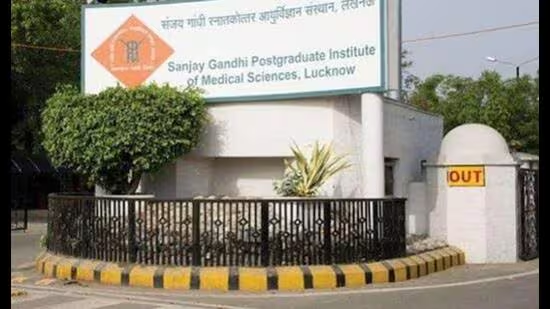
Lucknow: Sanjay Gandhi Postgraduate Institute of Medical Sciences (SGPGIMS) has successfully performed its first haplo-identical bone marrow transplant for a 5-year-old child suffering from the rare genetic neurological disorder X-linked Adrenoleukodystrophy (X-ALD). The child’s father acted as the life-saving donor for this complex procedure, carried out under the National Programme for Rare Diseases.
Dr. Sayan Sinha Roy, Assistant Professor in the Department of Hematology, said this is SGPGIMS’s first successful bone marrow transplant for X-ALD in North India. The achievement was accomplished under the leadership Dr. Rajesh Kashyap, Head, Department of Hematology. Key members of the transplant team included lead consultant Dr. Sayan Sinha Roy, resident doctors Dr. Luis and Dr. Chandrachud, Senior Technical Officer Manoj Kumar Singh, and Dr. Kaushik Mandal, HoD, Medical Genetics and Dr. Deepti Saxena from the Department of Medical Genetics.

Dr. Roy explained that X-linked Adrenoleukodystrophy (X-ALD) is a rare genetic disease caused by mutations in the ABCD1 gene. This leads to the accumulation of very long-chain fatty acids (VLCFA) in the body, which damages the myelin layer that protects the brain and nervous system, and also affects the adrenal glands. The disease mainly affects boys and can cause rapid neurological deterioration if treatment is not received in time.

He added that Hematopoietic Stem Cell Transplant (HSCT), or bone marrow transplant, is the only effective treatment to halt disease progression. The best outcomes are seen when the transplant is done in the early stage of the disease, before severe symptoms develop. This success is a significant example of SGPGIMS’s expertise and advanced transplant services in the treatment of rare genetic disorders.
Padmashri Dr. R. K. Dhiman, Director, SGPGI congratulated the entire transplant team on this landmark achievement and said, “This achievement underscores SGPGI’s commitment to excellence in advanced patient care, research and innovation. It demonstrates the strength of our multidisciplinary teams and reinforces our resolve to provide state-of-the-art treatment for patients with rare diseases. We congratulate the transplant team and the family on this successful outcome, which brings new hope to many children affected by such disorders.”